
Trustless Messaging Protocol
$The Trustless Messaging Protocol (TMP): blockchain messenger secured by blockchain consensus.
What is TMP
TMP is a protocol for transporting any consensus-committed blockchain data (smart-contract events, transactions, storage slots) from a chain to any external destination (another chain, an off-chain component, an institutional system).
No intermediary attests to message validity — not a multi-sig committee, not a federation, not the relayer itself. The destination accepts a message only after cryptographically verifying the source chain's consensus, either by running that verification directly on the destination (direct mode) or by checking a succinct zero-knowledge proof that it was run (zk-proof mode), trusting the consensus, not anything else. That is what makes the protocol trustless. Relaying is permissioned as an operational defense-in-depth layer, but it is not a trust gate for validity: a relayer can delay a message, it can never forge one (see Messenger § Security model).
Why it exists
Almost every blockchain is secured by a carefully designed consensus engine and a battle-tested network of nodes — but the way applications talk to blockchains from outside isn't. Bridges and cross-chain messaging today rely on trusted intermediaries: multi-sig committees that oversee the source chain and relay its data. The trust model is bolted on top of, not inherited from, the chains themselves.
That trust model has been the failure mode behind nearly every major bridge exploit:
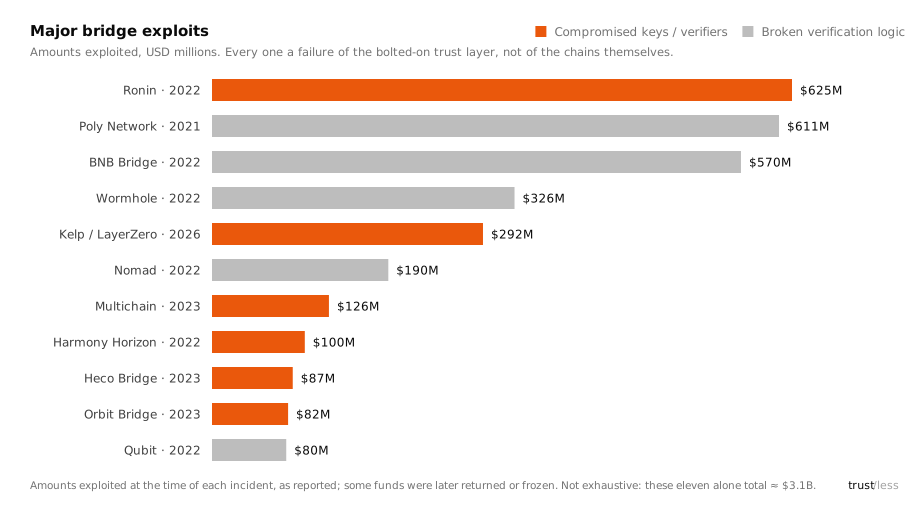
Even when it doesn't fail, the trust is expensive. Whether a protocol runs its own internal multi-sig or pays an external validator set, what you're paying for is the cost of trust: intermediaries re-asserting what the source chain has already cryptographically committed (integrating a bridge service often costs millions).
By verifying for itself that the data was committed on the source chain, TMP removes the need to rely on a third-party trust layer, replacing the bolted-on trust layer with the security the source chain already provides. This is the strongest security model achievable, with virtually no trust assumption other than the source chain consensus (which you already rely on in the first place).
| TMP | Multisig / validator bridge | |
|---|---|---|
| Security | Very high | Low |
| Cost | Low | High |
| Scalability | High: low infrastructure requirements | Low: complex infrastructure doesn't scale |
| Versatility | Any blockchain message | Only pre-defined types |
| Applicability | Generic blockchain data integration | Only cross-chain bridge |
Functionality
A Message in TMP is any piece of blockchain data (a smart-contract event, a transaction, or a state slot value) whose commitment to the source chain can be proven via the chain's consensus rules.
TMP can turn a blockchain (the chain as a whole, not a single node) into a conventional database in the sense that you can API-call it and get a verifiable response: the truthful return of an on-chain request or query, packaged as a blockchain message. This is the missing primitive for any application that needs trustworthy blockchain data integration.
Example use cases:
| Blockchain message | Application |
|---|---|
| Smart-contract events | Cross-chain bridges, oracles |
| Transactions | CEX deposit confirmation |
| State slots | Proof of on-chain storage |
Mechanism
TMP uses consensus verification to verify consensus-finalized messages. At a high level, the verification process is:
- Block Verification: prove that the block containing the message is finalized by the source chain's consensus.
- Block Inclusion Verification: given the finalized block, prove that the message is included in that block.
The full technique is specified in Consensus Verification.
With those terms in place, TMP works as follows:
- TMP runs consensus verification on each message before it is delivered to the destination application.
- If verification passes, the message is routed to the destination application.
- Consensus verification can be computationally heavy, and whether a destination can afford to run it is known up front: it follows from the source chain's signature scheme and the destination's native primitives. So the verification mode is fixed when the light client for a (source, destination) pair is deployed, and the matching verifier is built in advance:
- Direct mode — the light client runs the consensus check on-chain itself.
- ZK-proof mode — for destinations that cannot run the check at acceptable cost: the relaying layer produces a succinct zero-knowledge proof that the check passed, and the destination verifies only the proof.
- The entire mechanism is implemented in the Messenger, the infrastructure layer that powers TMP. See Messenger for the architecture.
Integration requirement
- TMP can only be integrated into blockchains whose consensus protocol allows for consensus verification, i.e., chains whose consensus engine commits to the data needed to determine that an event has taken place on-chain, e.g., a state slot, a transaction status, or an event log.